
By: NEJ Communicators
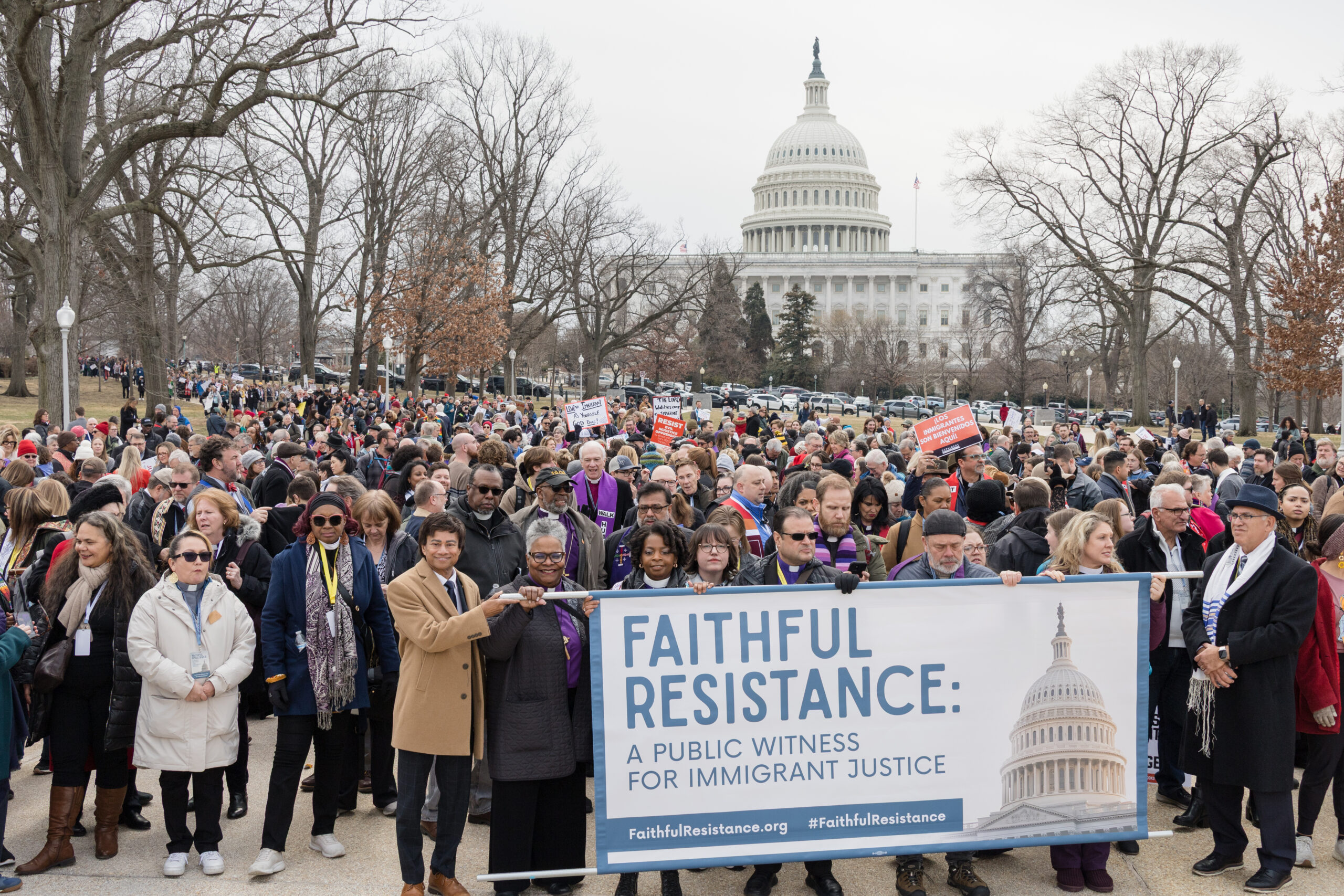
Faith calls people not only to believe, but to act. On Wednesday, February 25, United Methodists and faith partners gathered in Washington, D.C., for Faithful Resistance: A Public Witness for Immigrant Justice, a day of worship, prayer, and advocacy calling for compassion and due process for immigrants.
Among them were United Methodists from across the Northeast Jurisdiction who traveled hours by bus, car, train, and plane, to stand together in the nation’s capital, joining voices with people of faith from across the country to live out their commitment to welcome the stranger and work for justice.
Faithful Resistance Worship Service
Before 1,200 faith leaders stepped into the streets of Washington, D.C., they gathered at Capitol Hill United Methodist Church, Ebenezer UMC, and St. Mark’s Episcopal Church, all at maximum capacity, to ground their public witness in worship. An estimated 2,000 more participants bore witness through the livestream.
The opening service of Faithful Resistance was more than a prelude to public witness. It was a theological declaration.
The Rev. Dr. Lydia Muñoz and the band of musicians and worship leaders led those who gathered in songs of resilient hope, singing, “Hope will not fail… Peace will not fail… Love will prevail.”
A solemn prayer of lament followed, naming those who have died and confessing the Church’s complicity and silence. (See list of names below.) “Forgive us for trusting order over compassion, policy over people, power over love,” the prayer declared. Lament gave way to resolve: that mourning must become resistance and repentance must become action.
When Bishop LaTrelle Miller Easterling, episcopal leader of the Baltimore-Washington and Peninsula-Delaware Area, rose to preach, the energy shifted from mourning to moral clarity.
Preaching from Psalm 24, “The earth is the Lord’s,” she began, repeating the psalmist’s words with unmistakable clarity. “The psalmist does not whisper. The psalmist does not negotiate. It all belongs to God.” In those opening moments, she reframed the national conversation on immigration as a theological issue.
Bishop Easterling declared that when “some lives are expendable, some families deportable, some children detainable,” we are acting as though we own what belongs to God. Saying plainly, “This is not just bad politics. This is bad theology.”
She named what she called the “Miseducation of the Baptized.” Christians, she warned, have too often defended policies that privilege wealth, whiteness, and Western passports while criminalizing Black and Brown bodies from the Global South.
Her words cut to the core of what it means to follow Jesus. If the gospel is truly good news, it must side with the oppressed, not in words only, but in action that aligns with the words our lips profess.
“Beloved, you cannot claim clean hands when those hands sign policies that cage children. You cannot purport pure hearts when those hearts fear refugees more than they fear injustice. You cannot preach the Beatitudes while endorsing systems that deny the poor access to safety, shelter, and dignity,” she said.
Bishop LaTrelle Easterling made it plain: “A gospel that does not side with the oppressed is not the gospel of Jesus Christ.” The congregation responded with visible and audible affirmation, standing in agreement with the call to moral clarity.
The service concluded with calls to collective action addressing state violence, racialized harm, family detention, and institutional failure. An interfaith affirmation proclaimed that no border or wall can erase sacred worth, and that immigrant rights are human rights.
Bishop Lanette Plambeck, resident bishop for the Dakotas-Minnesota Area, gave the closing charge and blessing, playfully drawing on Jesus’s words about being the salt of the earth and the light of the world: “We discovered in upper Minnesota that the best way to deal with ICE is to throw down some salt. Go and get salty and lit,” she proclaimed.”
A public witness that stretched more than a mile
Following the church service, leaders from across the connection led the way as clergy and lay people from across the denomination marched and sang “Walking in the Light of God.” The sound of their singing and the truthfulness of their public witness echoed through the streets as they marched from Capitol Hill UMC, past the Capitol Building and the Supreme Court, to Upper Senate Park, where the public witness continued.
Bishop Minerva Garza Carcaño’s opening remarks framed the time of public witness, “We declare that every person, without exception, is a child of God and thus a person of sacred worth. We stand together for immigrant justice.”
In addition to Bishop Carcaño, lawyers active in immigration justice, congressional representatives, and faith leaders addressed the crowd.
Chris Newman, legal director of National Day Labor Organizing Network, addressed the crowd, “Authoritarianism starts with the scapegoat, but it never ends there… the attack on immigrants has never been about immigration… They are all about accumulating, wielding and abusing power.”
Representatives Shri Thanedar, Mary Gay Scalon, and Delia Ramirez each greeted the crowd. Rep. Thanedar spoke of his work with the Abolish ICE Act. Rep. Scalon exhorted the crowd to continue to be salt and light. Rep. Delia Ramirez, a lifelong United Methodist, spoke of the ways that her experiences as a Methodist informed her present political action, and encouraged those gathered to continue to be faithful in resisting the forces of wickedness and oppression.
In the face of those forces, I need to ask you to continue to be an instrument of peace. I need you to love where there is hate. I need you to forgive where there is injury. I need you to hope where there is doubt. And yes, I pray for a deliverance from the forces that would diminish, detain, deport, and dehumanize us, but I also know that in that prayer God calls us to action. Instruments of peace do the work in prayer and in policymaking.
The Rev. Leslie Copeland-Tune, chief operating officer for the National Council of Churches, called upon those gathered to remain faithful, even in challenging and dangerous times. She invited the assembly to turn to the Capitol and the Supreme Court and declare, “We believe in freedom and we will not rest until it comes.”
After other leaders shared, Bishop Trimble closed the remarks and the crowd departed. Some made their way home, others left to make visits with congressional offices, and others strategized on how to continue to resist the forces of evil and oppression. All left edified and encouraged to continue pursuing the cause of justice in all the places to which God would send them.
Faith is meant to be embodied
The word proclaimed, the songs sung in resistance, and the speeches given were powerful, but the Faith Resistance was more than what happened in Washington. Thousands of United Methodists took action in their context. Some held watch gatherings for the service, others prayed over the event from afar, and others still found ways to make a public witness in their hometown. Next week, we’ll hear their stories and share resources that will empower you to continue to live out your faith through action.
In the meantime, there are ways that you can carry the power of the day with you. Below you’ll find the list of those who have died at the hands of ICE, that you may lift in prayer in your local church. You will also find a link to Bishop Easterling’s sermon.
Read Bishop Easterling’s Sermon
Names read during the Prayer of Lament for Complicity, Silence, and the Dead
2025:
Genry Ruiz Guillén, 29, Honduras
Juan Alexis Tineo-Martinez, 44, Dominican Republic
Brayan Rayo-Garzon, 27, Colombia
Nhon Ngoc Nguyen, Vietnam
Maksym Chernyak, Ukraine
Serawit Gezahegn Dejene, Ethiopia
Marie Ange Blaise, 44, Haiti
Abelardo Avelleneda-Delgado, 68, Mexico
Jesus Molina-Veya, 45, Mexico
Isidro Perez, 75, Cuba
Tien Xuan Phan, 55, Vietnam
Chaofeng Ge, 32, China
Ismael Ayala-Uribe, 39, Mexico
Oscar Rascon Duarte, 58, Mexico
Huabing Xie, China
Francisco Gaspar-Andres, 48, Guatemala
Silverio Villegas González, 38, Mexico
2026:
Luis Gustavo Nunez Caceres, 42, Honduras
Geraldo Lunas Campos, 55, Cuba
Victor Manuel Diaz, Nicaragua
Keith Porter, 43, United States
Renee Nicole Good, 37, United States
Alex Pretti, 37, United States