
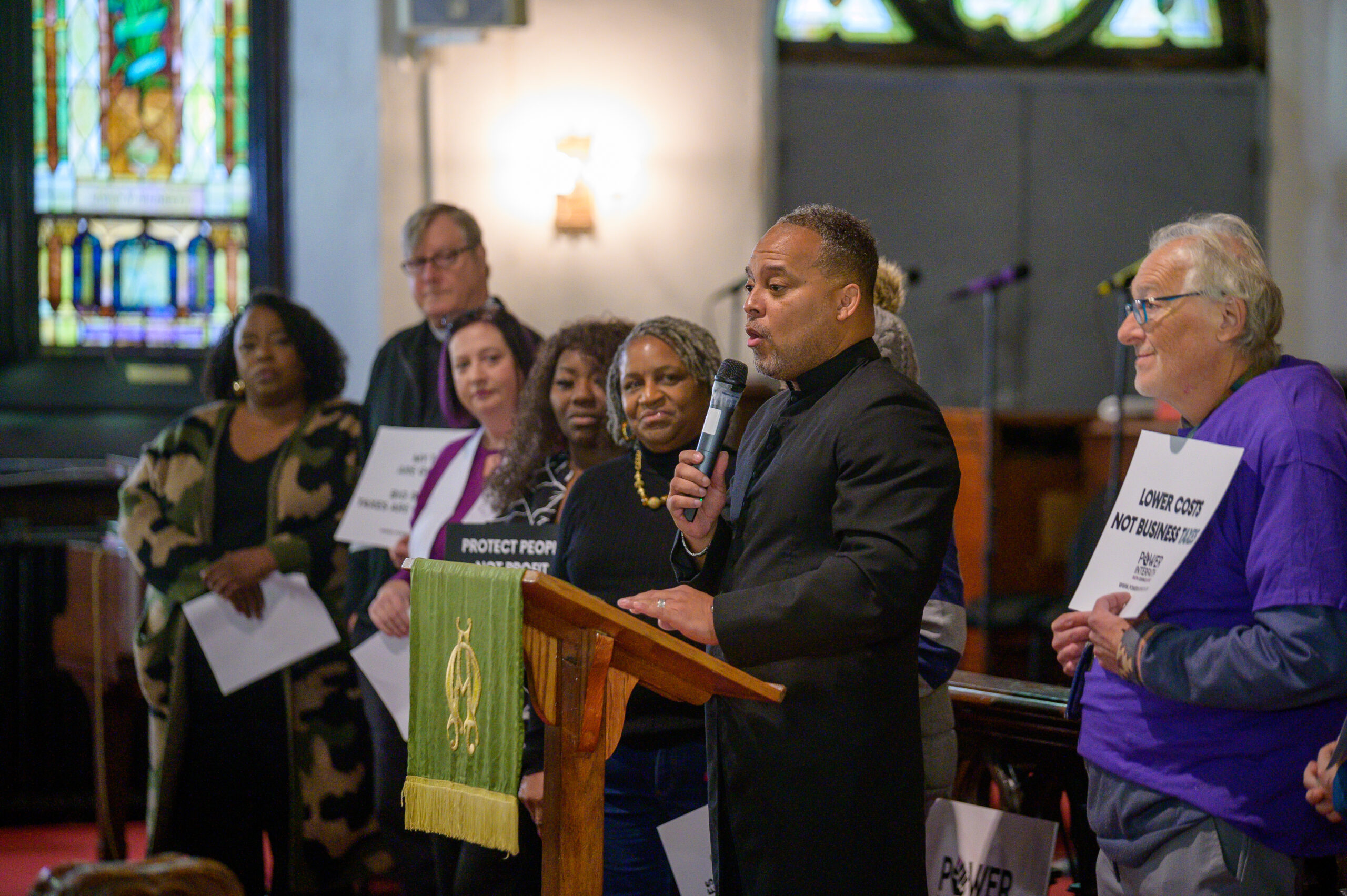
On November 12, Philadelphia community leaders, service providers, and residents filled the sanctuary of Mother African Zoar UMC to raise a unified alarm about a crisis they say is devastating the lives of Philadelphians. Affordability of basic needs—housing, food, utilities, and transportation– is slipping further out of reach, and the consequences are visible across every neighborhood.
The gathering was one of several coordinated press conferences organized by POWER Interfaith, a network of faith-based and civic groups that has spent more than a decade advocating for economic justice, public education, and community safety. Congregations across the city joined this coordinated effort to highlight how rising costs and stagnant wages are driving residents into instability.

Speakers spoke of unsustainable housing costs, inadequate wages, cuts to federal assistance, and a support system strained beyond capacity. The tone alternated between somber and urgent. At times, it was deeply personal.
What emerged was a story of a city struggling to meet its most basic needs—and of locals trying to fill widening gaps.
The concerns raised at the press conference reflect a broader regional trend. Philadelphia’s affordability challenges have accelerated in recent years:
- More than half of all renters in the city are considered cost-burdened, spending over 30% of their income on housing.
- Median rents in Philadelphia have risen roughly 30% in five years, with some neighborhoods experiencing steeper increases.
- Sources show a double-digit increase in homelessness, including a rise in residents sleeping outdoors.
- Pennsylvania’s minimum wage remains at $7.25/hour, even as living-wage estimates exceed $20–$25 an hour for a single adult.
- SNAP emergency allotments introduced during the pandemic ended in 2023, reducing benefits to just $250 per household per month.
For organizations on the ground, these statistics are not abstract—they shape their daily operations.

“We see the line grow longer every day,” said Deaconess Darlene DiDomineck, who directs a daytime drop-in center at Arch Street UMC. “More than a thousand new individuals came seeking help this year—people who have never before accessed our services.”
Her team has expanded meal service by 10 percent, yet still runs out in under an hour.
“The question,” she told the room, “is not how do we serve more, but why are so many in need in the first place?”
DiDomineck’s data framed the broader context, but the most gripping testimony was from Terica Green, a mother of ten who shared the story of her family’s long struggle to find safe, stable housing.
She described years of sleeping on the floor of a rundown apartment—receiving no help for the infestations or water damage, all while being told by the city that she would have to wait.

“I had to lay on the floor for four years,” she said. “I cried. I tried to act like I was somebody I wasn’t. But all those little babies I had—I had to make it work.”
Her story captured the emotional toll behind the statistics. She spoke of keeping her children’s hopes alive with stories she wasn’t sure were true, of sending them to stay with relatives when conditions became too dangerous, and of feeling trapped within a system that offered few realistic paths forward.
“This is a face that’s covered right now,” she said, her voice shaking. “It’s not the real me. It’s what I’ve become because I’m afraid to step out and do things.”
Her testimony underscored a theme that ran through the morning: residents are doing everything they can, but they are not being met with the support they need.
Other speakers echoed the pressures created by rising costs.
Millicent Clark, who directs United Methodist Neighborhood Services—a food and clothing pantry on West Lehigh Avenue—described the sharp increase in residents requesting emergency assistance.
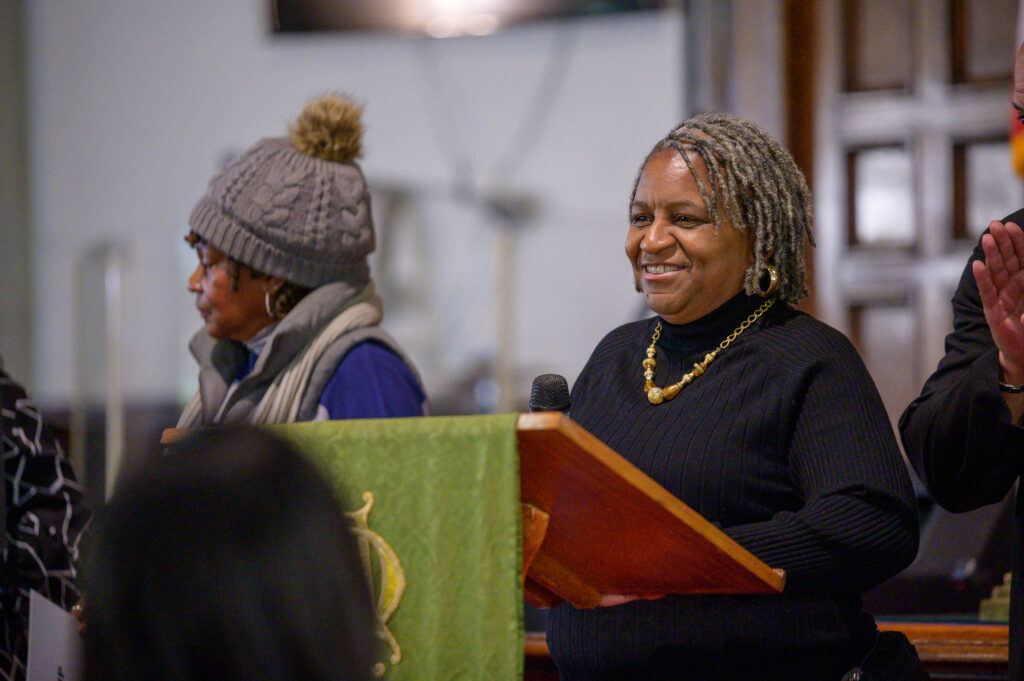
“We’re receiving a spike in calls for rental assistance, security deposits, utility bills, and help finding anywhere to go because they have nowhere to live,” she said.
Clark also shared her own family’s experience: her 92-year-old mother, a homeowner for decades, watched her property taxes climb from $222 to over $3,000 due to rising valuations and tax shifts tied to redevelopment.
“With the new homestead exemption, it’s going to rise again,” Clark said. “City Council, we want answers.”
Her remarks reflect a citywide trend. Property values in many neighborhoods—especially those facing gentrification—have risen sharply, leaving longtime residents with escalating tax bills even if their incomes remain fixed.
For low-income homeowners, seniors, and families already facing financial strain, the compounding effect is costing residents their homes.
Leaders from POWER Interfaith and the UMC emphasized that this press conference was part of a broader strategy. To “flood the media” with stories, exposing the reality of affordability in Philadelphia.
Speakers urged elected officials—from City Hall to Harrisburg to Washington—to adopt policies that address these issues holistically.
Their demands included:
- Raising Pennsylvania’s minimum wage to a living wage
- Increasing Social Security and disability benefits
- Expanding deeply affordable housing
- Strengthening oversight of housing assistance programs
- Reassessing tax abatements and subsidies given to corporations
- Restoring and protecting SNAP benefits
- Increasing transparency in city housing programs
The coalition’s argument was simple: charities and churches cannot solve structural affordability problems alone.
As DiDomineck put it, “This is not the way of a healthy community. Poverty is not an act of God. It is the result of policies and priorities—and those can change.”
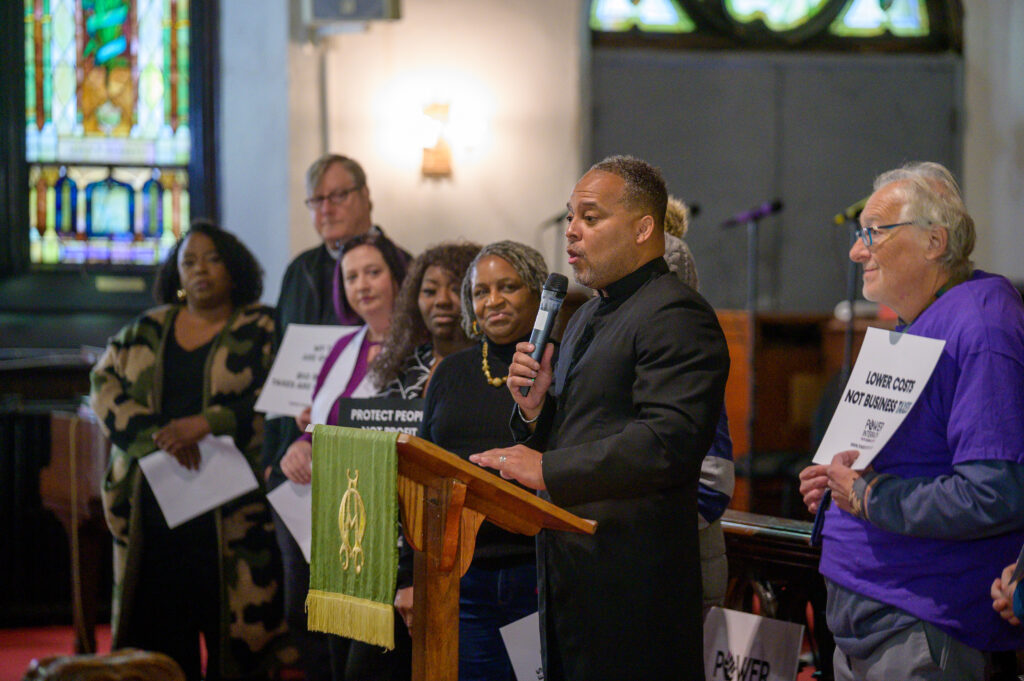
Rev. Brawner added wisdom from 2 Thessalonians 3:10. The verse reads, “anyone unwilling to work should not eat.” Brawner labeled the word “unwilling” as a poor translation, offering instead, ‘out of order’ as its more accurate meaning. He expanded, “It’s the systems of corporate greed, private equity, and colonial extraction that are out of order.”
The concerns raised by speakers reflect ongoing policy debates across the region.
City Council has recently introduced measures aimed at increasing affordable housing development and strengthening tenant protections. Mayor Cherelle Parker has prioritized public safety and economic mobility, with plans to invest in housing repairs and neighborhood revitalization.
But many advocates argue that the scale of the crisis exceeds the pace of policy change.
Statewide, efforts to raise the minimum wage have repeatedly stalled in the legislature. Neighboring states such as New Jersey, New York, and Delaware have all increased their minimum wages significantly in recent years, creating growing pressure on Pennsylvania to revisit its wage floor.
For residents like Terica Green, the gaps between policy and lived experience can mean years of uncertainty.
Although the tone of the morning was focused on civic issues rather than religious doctrine, it was not lost on attendees that Mother African Zoar—the host of the event—occupies a significant place in Philadelphia’s history.
Founded in the 1790s, the congregation emerged during a period when African American worshippers were barred from certain churches. It has long served as a community anchor, offering support, education, and advocacy through periods of inequity and transition.
By choosing to host the press conference there, organizers underscored the continuity between past and present struggles for justice and economic dignity.
As the press conference drew to a close, leaders made one final appeal: meet with us.
Their goal is to sit down with elected officials across multiple levels of government to discuss long-term solutions to affordability challenges.
The coalition framed the issue as one requiring structural—not symbolic—change.
Their priorities include:
- ensuring that deeply affordable housing is developed at a scale matching the need
- increasing oversight of housing assistance programs
- expanding public investment in families facing insecurity
- ensuring that new developments do not displace existing communities
- strengthening supports for children who rely on schools for food and stability
One speaker pointed to students at a nearby elementary school who rely on school meals as their primary source of nutrition.
“These are the children that are supposed to be our future,” he said. “And these are the children we must protect.”
In a city confronting rising costs, deepening inequity, and increasing pressure on social services, the press conference at Mother African Zoar served as both a warning and a call for collaboration.
Speakers made clear that they see affordability not as a single-issue challenge but as a reflection of overlapping systems—housing, wages, food security, public benefits, and neighborhood investment—all of which shape whether families can build stable lives.
Their message was framed in practical terms: local organizations are attempting to meet the growing need, but they cannot do it alone.
As residents filed out of the sanctuary, the urgency of the morning lingered. The testimonies, statistics, and appeals delivered from the podium painted a picture of a city where too many hard-working people are falling behind—a city where the cost of living is rising faster than the support systems meant to sustain its people.
Whether the coordinated effort of POWER Interfaith and local congregations will spur broader policy change remains to be seen. But for the community members gathered at Mother African Zoar, raising the alarm was a necessary first step.
“We’re already doing our part,” one organizer said. “Now the systems around us have to change, so poverty can finally become part of our past instead of our present.”