
On October 7, 2026, United Methodists from across Eastern Pennsylvania and Greater New Jersey gathered with members of the African Methodist Episcopal (AME) Church for a time of sacred storytelling and, for United Methodists, repentance.
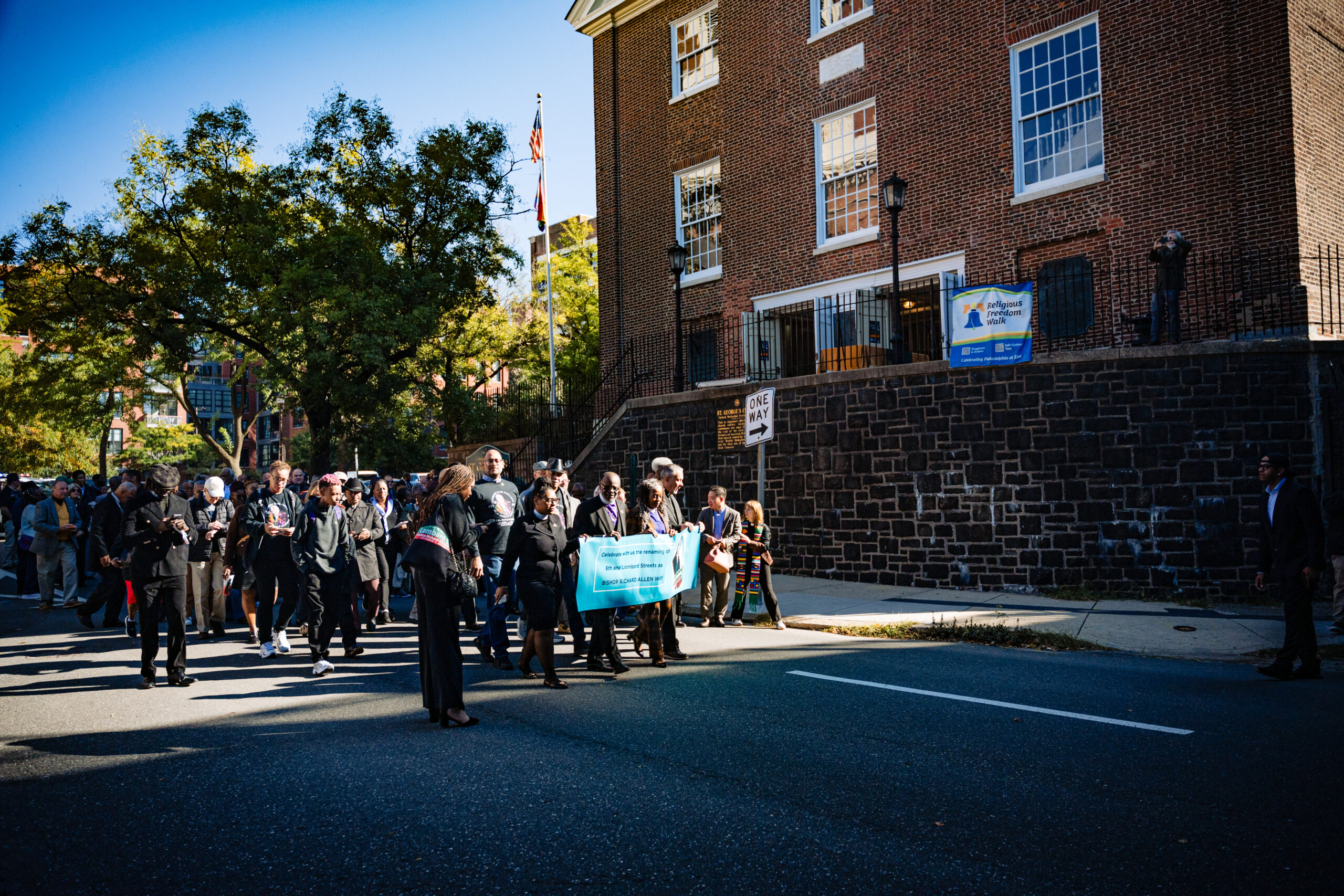
More than two centuries after Richard Allen and Absalom Jones walked out of Historic St. George’s Methodist Church in protest of racial discrimination, United Methodists and members of the African Methodist Episcopal Church retraced their steps through the streets of Philadelphia. What began as a solemn pilgrimage of remembrance and repentance culminated in a joyful celebration of Bishop Richard Allen’s enduring legacy and the unveiling of a street sign bearing his name.
The day began with an opening service at Historic St. George’s United Methodist Church at 4th and Arch Streets. St. George’s was the church where Richard Allen and Absalom Jones held their membership and received their licenses to preach. It was also the church whose racist practices eventually drove them from the congregation.
Faith leaders from both The United Methodist Church and the African Methodist Episcopal Church each offered reflections on the significance of the day.
The Rev. Dr. William Wilson Sr., current pastor of Historic St. George’s, welcomed those gathered and, in his opening remarks, emphasized why occasions like this are so important.
“We have stories that are not blessed, but must be told, so that we don’t repeat it in the future.”
Bishop Cynthia Moore-Koikoi spoke to the significance of the moment.
“This is a day when resurrection people hold to different emotions simultaneously. We hold lament and celebration. As resurrection people we hold both repentance and affirmation this day. As resurrection people we celebrate that we worship a God who is about redemption.”
Bishop Samuel Lawrence Green Sr., Presiding Prelate of the First Episcopal District of the AME Church, spoke on the theme of reconciliation.
“We believe that God is a reconciling God, that God is a God of healing. Our differences do not have to cause us to be different to each other. The walk out in 1787 now becomes the walk with.”
The Rev. Carolyn Clarene Cavaness, 53rd pastor of Mother Bethel AME Church, reflected on the importance of celebrating Black excellence.
“As we celebrate this bicentennial, it’s been critical for us to celebrate and uplift black excellence from this nation’s very beginning. When others have shut us out and said we aren’t good enough, we have garnered our own energy and resources to build. We are grateful for the witness of Richard Allen and many, many others.”
Rev. Dr. Wilson then read from Bishop Richard Allen’s journal, recounting a painful moment in Methodist history that must be told so that it might never be repeated.
“We had not been long upon our knees before I heard considerable scuffling and low talking. I raised my head up and saw one of the trustees, H- M-, having hold of the Rev. Absalom Jones, pulling him up off of his knees, and saying, ‘You must get up—you must not kneel here,’ Mr. Jones replied, ‘wait until prayer is over.’ H-M- said ‘no, you must get up now, or I will call for aid and I force you away.’ Mr. Jones said, ‘wait until prayer is over, and I will up and trouble you no more.’ With that he beckoned to one of the other trustees, Mr. L-S- to come to his assistance. He came, and went to William White to pull him up. By this time prayer was over, we all went out of the church in a body, and they were no more plagued with us in the church.”
On that day in 1787, Richard Allen, Absalom Jones, and other Black worshippers walked out of St. George’s. They would go on to form their own faith community, where the basic human dignity of African American people would never be questioned. After the reading ended, Rev. Dr. Wilson, Sr. offered a prayer, and then the gathered assembly took the same steps Richard Allen once did, out of the church’s doors.
The sun shone brightly as marchers made their solemn pilgrimage to the place where the City of Philadelphia would forever memorialize Bishop Richard Allen’s legacy.
The atmosphere shifted from solemn reflection to joyful celebration as the marchers arrived at 6th and Lombard Streets, where a new street sign would be unveiled, officially renaming that section of Lombard Street as Bishop Richard Allen Way.
Baba Anssumame opened the program with the beating of the drum, followed by a welcome from Miss Trinity Williams. Mrs. Sharon Gary Dixon sang the national anthem, and Ms. Danille Shaw raised her voice to lead those gathered in the Black national anthem.
The Very Rev. Canon Martini Shaw of the African Episcopal Church of St. Thomas offered an invocation.
“O God of our weary years and God of our silent tears, thou who has brought us thus far on the way… may everyone who travels on this way be reminded of the faith that sustained [Bishop Richard Allen], the hope and the courage that carried him through.”
Philadelphia City Councilmember Mark Squilla, representing the First District, offered opening remarks, recalling Bishop Allen’s contributions to both the church and the wider community.
Squilla recounted how, during the yellow fever epidemic of 1793, Philadelphia’s mayor sought assistance from the Free African Society, which Bishop Allen helped lead. The society responded by providing aid to hundreds suffering throughout the city.
“We understand as we do these things, it’s not just names on the street. This is a way that, as a city, we can remember those who made us who we are,” Squilla remarked.
Rev. Cavaness offered a reflection that connected the assembly to the significance of the site and invited those gathered to see themselves as part of the continuing story.
“On Oct 10, we will celebrate the 230th year in which Bishop Allen purchased 6th and Lombard. This is the oldest parcel of Land continuously owned by African Americans in the United States. This land is just as old as the country.”
She celebrated how Bishop Allen’s actions, both in walking out to protest racial injustice and in purchasing the land, demonstrated that he was thinking “seven generations ahead,” echoing an Indigenous philosophy that encourages people to consider how their decisions will affect the next seven generations.
Bishop Green rose to offer a poetic reflection on what it means to follow the way of Bishop Richard Allen.
“The Bishop Allen way is protestation against inequality, injustice, racism, hate, sexism, and ism that doesn’t promote and elevate life, unity, and happiness. The Bishop Allen way is one way, and one away in the love of Philadelphia, one way in brother love and sisterly affection.”
The Honorable Timothy J. Cager, 107th Grand Worshipful Grand Master of the Most Worshipful Prince Hall Grand Lodge of Free and Accepted Masons of Philadelphia, brought greetings.
Philadelphia City Council President Kenyatta Johnson remarked, “This is an opportunity for us to make sure that we continue the life and legacy of an outstanding African American.”
Philadelphia Mayor Cherelle L. Parker drew attention to a word that had echoed throughout the day’s remarks: legacy.
“There is one word that is resonating here today. That word is legacy… today we get to remind the world of Bishop Richard Allen and his legacy. If we don’t document things and do things for the record, you don’t know when someone is going to come behind you and write a whole new story.”
Following remarks from the dignitaries, Mr. Marques Daughtry, portraying Bishop Richard Allen, greeted the guests.
“I count this as a blessing to stand among you on this occasion. A reminder of a people who have refused to be denied their legacy. The strengths of your ancestors are part of your inheritance. May those who pass along this way always remember that faith requires courage, freedom requires actions, and progress requires that we stand together.”
Mrs. Yvonne Studevan, the great-great-great-great-granddaughter of Bishop Richard and Sarah Allen, spoke on behalf of the family.
“It is with heartfelt gratitude and profound pride that we, the descendants of Richard Allen, are here today in the city of brother love. This moment is more than a naming of a street, it is a public declaration that Richard Allen’s life, faith, courage, and contributions matter and that legacy will continue to move forward through the generations.”
Finally, the long-awaited moment arrived. The street sign was unveiled, marking a new chapter in the history of Philadelphia, where Bishop Richard Allen’s legacy and generations of Black excellence would be publicly recognized and celebrated.
Bishop Cynthia Moore-Koikoi offered the closing prayer and benediction. She prayed for a hedge of protection around all of Richard Allen’s descendants and for the gift of reconciliation among those gathered, so that through their unified witness, the world might come to see and know God.
As the service ended, participants gathered to break bread together in the historic Fellowship Hall of Mother Bethel AME. That moment of companionship put flesh around the words that Bishop Green spoke earlier in the day, “God is a reconciling God… God is a God of healing. Our differences do not have to cause us to be different to each other. The walk out in 1787 now becomes the walk with.”
More than two centuries after Richard Allen walked out of St. George’s in protest, members of The United Methodist Church and the African Methodist Episcopal Church chose to walk with one another, to remember together the history of injustice experienced, so that it would not be repeated. Together, the two walked in the Bishop Richard Allen Way and were reminded that his legacy is not simply a story to be remembered, but a call to continue the work of justice today.