
BY JOHN W. COLEMAN
In its fall 2018 Call to Action report to the Northeastern Jurisdiction Vision Table and Episcopacy Committee, the Eastern PA Conference reported strides and next steps that suggest real movement against racial ignorance and inequity that have too long seemed rooted in place. Conference Commission on Religion & Race leaders will present and update that report at our 2019 Annual Conference.
Indeed, last year may have been a turning point in the conference’s renamed Racial Justice Transformation Process, an ambitious response to the NEJ’s Call to Action* initiative. Now it remains to be seen if the candid dialogues and revealing analyses that emerged can lead to deep learning and real change.
Those dialogues were part of an intensive “institutional racism audit” that engaged racial-ethnic groups and conference leaders in separate, guided discussions facilitated by expert consultants. Their discussions yielded subsequent learnings, followed by further listening sessions hosted by Bishop Peggy Johnson and the Rev. Anita Powell, Director of Connectional Ministries.
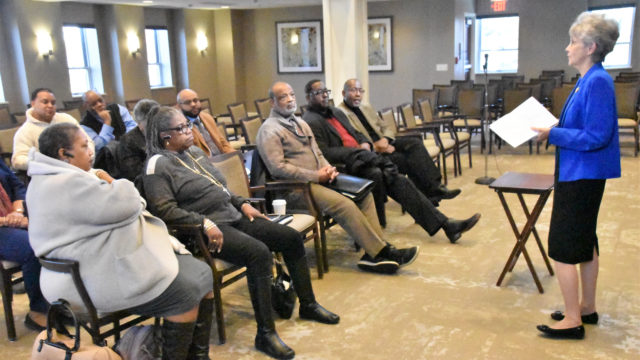
The bishop held follow-up talks with Latino, Korean and Indian groups and with the Committee on Native American Ministries in late 2018, and then with clergy of African descent (including those from Africa and the Caribbean) March 23.
“These ongoing talks are a part of our journey of racial reconciliation and the building of the ‘beloved community,’” said the bishop, who has led her Cabinet to support the Call to Action initiative by example. The report highlights her and the superintendents’ own racial learning efforts, including study, participation in dialogues and training events, and visits to racial-ethnic churches.
“The CTA is part of a long process of storytelling, relationship-mending and barrier-dismantling that must continue on and on,” she explained. “The work is never ‘once and done.’ The Call to Action is a call to a lifetime of learning, growing and healing.”
The conference’s overall work in this initiative seeks to “engage and equip congregations, clergy, ministry candidates and staff in seeking inclusion and equity while serving their communities.” The goal is to “create opportunity for changing systems” and ultimately, to dismantle institutional racism.
The changes leaders want to see include:
- Wider capability among members to engage in “difficult conversations about race with progressive understanding.”
- “Shared decision-making and shared power,” where the participation, viewpoints and influence of people of color are valued.
- More “financial equity in employment, clergy appointments and compensation for everyone.”
- Compared to other NEJ conferences, there is remarkable racial-ethnic diversity in our conference, including:
- 27 predominantly black churches out of 415, plus 13 Latino churches and faith communities, and five Korean churches.
- About 44 pastors and deacons of African descent serving churches, plus about 12 Latino pastors, 11 Korean pastors and six who are from India. Many of these pastors are serving in cross-racial/cross-cultural appointments.
- Significant numbers of staff, cabinet and elected conference leaders of African descent, plus Latino and Korean staff and elected leadership as well.
- At least three active, influential, representative racial-ethnic groups who have met with the bishop and conference staff: Black Methodists for Church Renewal, the Latino Commission and a Korean-American clergy group from the Eastern PA/Peninsula-Delaware conferences combined.
- The Committee on Native American Ministries (CONAM)—although there are very few Native people in our conference—and a small group of clergy from India also have met with the bishop for discussion of racial justice concerns.
- While such diversity is not new for Eastern PA, the scope of in-depth conversations, ambitious visions and intentional plans generated by the Butterfly Project was remarkable. They include:
- Information and dialogues on implicit bias and white privilege to assist the Board of Ordained Ministry in its consideration of candidates and to help other groups.
- Deliberate inclusion of people of color in interviews and judgment of ministerial candidates.
- A series of Whites Confronting Racism Workshops that convened in March and will continue in July and September. The intensive but “compassionate, nonjudgmental” workshops are designed for white people who “want to understand the dynamics of racism in our society and within themselves” and who are willing to “commit to the ongoing work of seeking racial justice in all aspects of their lives and to influencing others to do the same.”
- Another workshop on internalized racism and resulting trauma for people of color, scheduled for Sept. 14, to be led by an author and expert on the subject.
- A request that conference ministry boards, councils and committees identify, initiate and report efforts to increase the participation and influence of people of color in their work.
- An extensive, strategic plan—led by the Cabinet, the Connectional Ministries Office and the Commission on Religion and Race (CORR)—to expand, promote and support opportunities for successful cross-racial and cross-cultural pastoral appointments as shared ministry between clergy and congregations.
- A goal to convene more district, church cluster and local church conversations on race. So far in 2019, two districts have convened such conversations. The East District gathered members to view a relevant documentary film and then discuss racial bias and injustice in America. The South District has convened a number of interracial table talks over dinners to help members become more aware of and sensitive to one another’s lives and concerns, including racial-ethnic differences.
- Efforts to provide Spanish and Korean-language translation and instruction at Annual Conference and major training events, like Tools for Ministry and the Laity Academy.
“In the many current and planned activities documented here, I am encouraged by the effort and attention being devoted to working toward the stated goals laid out in the NEJ Call to Action Resolution,” said the Rev. Susan Worrell. She prepared the CTA report on behalf of CORR, which she co-chairs, using information provided by leaders of conference groups, districts and local churches.
“As greater understanding and cultural humility is sought by those who have for so long been granted power,” she continued, “relationships across ethnic boundaries will be forged and hearts will be changed, leading to transformed systems. This is my prayer for us all.”
Each conference’s Call to Action report is submitted annually to NEJ leadership, and a quadrennial report is due to be submitted in 2020, showing progress in achieving racial progress goals. The 2018 report and past reports can be found on the conference’s Religion and Race webpage.
The *Call to Action resolution for racial justice was endorsed unanimously by annual conference delegates and bishops at the 2016 Northeastern Jurisdictional Conference. It contains detailed recommendations that call on each conference to do more to confront and dismantle racism and discrimination, both interpersonal and institutional, to push for systemic change in pursuit of racial justice and progress, and to affirm that all lives matter in God’s eyes